
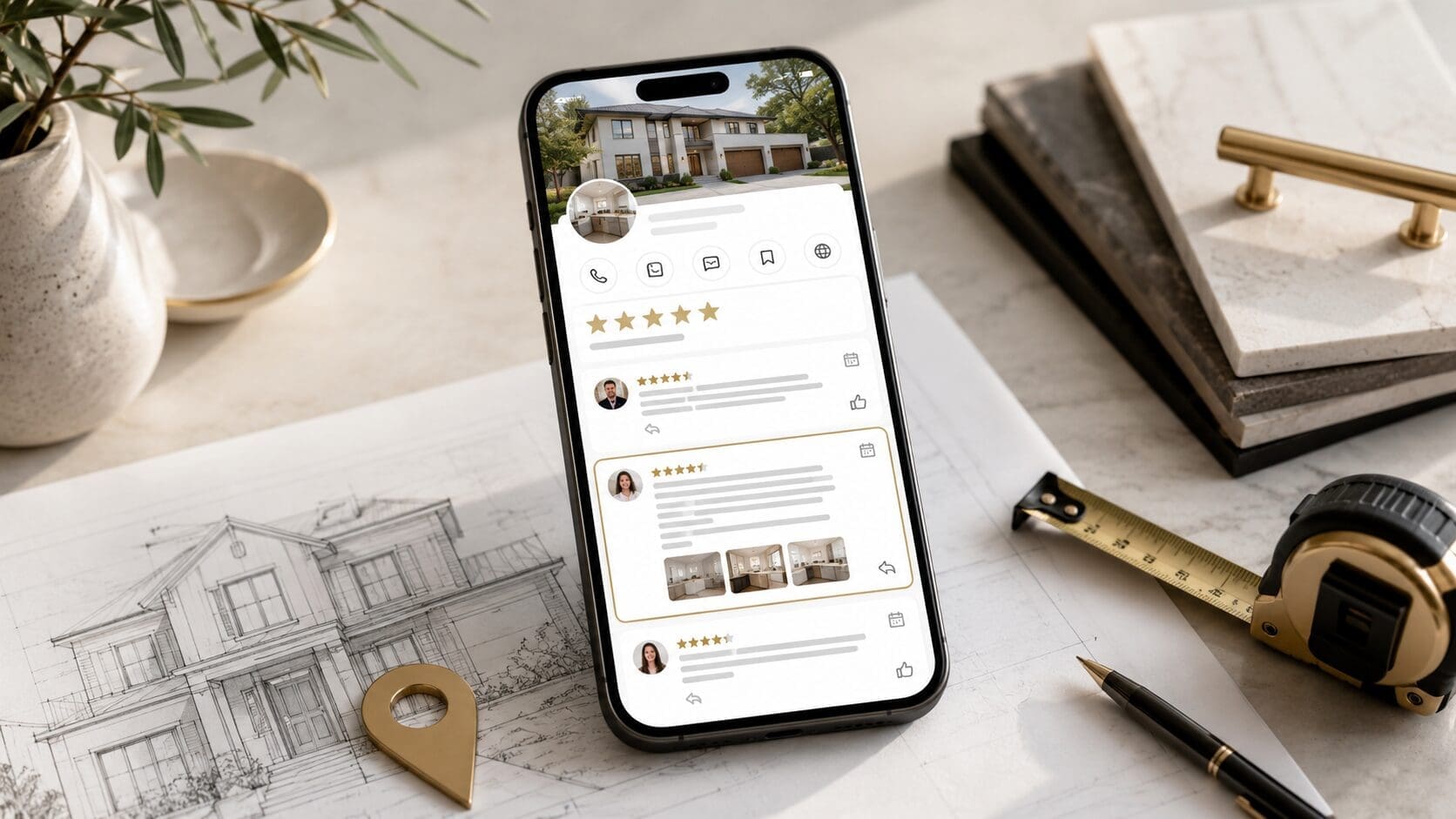
The review count, the recency, the response, and the one detail homeowners scan for before they ever call.
Every contractor wants a five-star average. It makes sense. It looks good, it feels good, and it signals to Google that your business is worth ranking. But if you’ve been focused on protecting that perfect score above everything else, you may be optimizing for the wrong thing.
Here’s what actually happens when a homeowner finds your Google Business Profile. They don’t look at your star rating and call. They scan. They’re looking for evidence that you’re the safe choice, and a five-star average alone doesn’t give them that. What they’re really reading is a story, and four things are telling it: how many reviews you have, how recent they are, whether you respond, and the detail hiding inside the reviews themselves that most contractors don’t even know homeowners are looking for.
Get those four things right and a 4.7 will outconvert a perfect 5.0 from a contractor who hasn’t thought about any of this.
The Rating Is the Floor, Not the Finish Line
A five-star average earns you a look. That’s it. It gets you past the first filter a homeowner runs when they’re scanning the map pack. Anything below a 4.3 or so and you’re losing people before they even read a word. So yes, the rating matters. But once you clear that threshold, the rating stops being the deciding factor. Everything else takes over.
Think about how you make a big purchase decision yourself. You see a product with 4.8 stars and 12 reviews. Then you see one with 4.6 stars and 347 reviews. Most people pick the 4.6. Not because they’ve done the math, but because volume feels like evidence in a way that a small perfect score doesn’t.
For contractors, this plays out the same way. A homeowner is about to hand someone $40,000 or $150,000 or more to work in their home. A thin review profile with a perfect average looks like it hasn’t been tested yet. A robust profile with a strong but not perfect average looks like a business that has been doing this for a long time and has earned its reputation.
Review Count: The Social Proof Threshold
The number that matters most varies by market, but as a general benchmark, crossing 25 to 30 reviews is where homeowners start to feel confident. Below that, the volume question is quietly working against you. Above it, the question shifts from “can I trust this business” to “which of these two businesses do I trust more.”
The practical implication here is that chasing a perfect score by being selective about who you ask for reviews is a trap. Contractors sometimes avoid asking certain clients because they’re not sure the review will be glowing. That caution feels protective but it’s costing you volume, and volume is doing more conversion work than the rating itself.
What to do: Ask every client. Not just the ones you’re certain will leave five stars. The occasional four-star review from someone who had a genuinely good experience but noted a small hiccup is not a liability. It’s credibility. A profile where every single review sounds the same starts to feel curated, and homeowners notice.
The system matters more than the ask. Build review requests into your close-out process. Send the direct link. Make it a one-tap action, not a scavenger hunt for your Google listing. The easier you make it, the more reviews you get.
Recency: The Detail That Signals You’re Still in Business
A contractor with 60 reviews and the most recent one from 14 months ago has a recency problem, and they probably don’t know it.
Homeowners aren’t just reading reviews. They’re checking the dates. A gap in reviews raises a quiet question: what’s been happening over there? It doesn’t matter that the business is thriving. The gap tells a different story, and the homeowner fills in the blank with something negative.
Google also uses recency as a ranking signal. A profile that’s collecting reviews steadily tells Google the business is active, trusted, and worth showing. A profile that went quiet tells Google the opposite.
What to do: The goal isn’t a flood of reviews all at once. It’s a steady stream. Two to four new reviews per month is enough to signal activity and stay competitive in most local markets. The way to make that sustainable is a process, not a push. Every completed project should trigger a review request within 48 to 72 hours, when the client’s satisfaction is freshest and the experience is still top of mind.
If you have a backlog of happy clients you never asked, now is a good time to reach back out. A simple message acknowledging it’s been a while and asking if they’d be willing to share their experience still converts, especially from clients who genuinely liked working with you.
Your Responses: The Part Most Contractors Skip Entirely
Most contractors don’t respond to their reviews. The ones that do usually respond to the negative ones and ignore the positive ones. Both are mistakes.
When a homeowner is scanning your profile, they read your responses. Not because they’re that interested in what you said to someone else, but because your responses tell them how you operate. They reveal your communication style, your professionalism, and whether you’re the kind of business that actually pays attention after the job is done.
Responding to positive reviews does three things. It shows the reviewer you noticed and you’re grateful. It shows prospective clients that you’re engaged and responsive. And it gives you a natural opportunity to mention a service or location, which is a soft SEO signal Google picks up on.
Responding to negative reviews is where most contractors either go defensive or say nothing at all. Both responses cost them clients. A calm, professional response to a critical review actually builds trust with the people reading it. It shows you’re accountable, that you communicate under pressure, and that you don’t disappear when something goes wrong. Those are exactly the qualities a homeowner wants in a contractor before they hand over a significant check.
What to do: Respond to every review within a week. For positive reviews, make it personal. Reference the project type, say something specific about the client experience, and end with a genuine thank you. For critical reviews, acknowledge the concern, avoid being defensive, and take the conversation offline by offering to connect directly. Never argue in public.
The One Detail Homeowners Are Actually Scanning For
Here it is. This is the thing most contractors never think about, and it’s doing more conversion work than almost anything else on the profile.
Homeowners scan the text of your reviews looking for project types that match their own.
Not the rating. Not your response. The words inside the review.
When someone is planning a kitchen remodel, they’re skimming your reviews for the word “kitchen.” When someone wants a deck built, they’re looking for “deck.” When a homeowner in a specific neighborhood is considering hiring you, they light up when they see their own area mentioned in a review.
This is called review specificity, and it’s the difference between a review that converts and a review that just adds to your count.
A review that says “great company, very professional, would recommend” is worth something. A review that says “hired them for a full kitchen gut and remodel in our 1960s colonial in Manassas, the team was on time every day, the tile work is immaculate, and they were honest about two surprises they found in the walls without padding the invoice” is worth ten of the first kind.
What to do: You can’t control what clients write, but you can influence it by what you ask. Instead of “would you mind leaving us a review,” try “if you’re willing to leave a review, it helps other homeowners most when you mention the specific project and your experience working with us day to day.”
That one sentence shifts the review from generic to specific. Over time, a profile full of specific reviews becomes a self-sorting filter that attracts exactly the kind of clients you want more of.
What This Looks Like When It’s All Working Together
A contractor with 4.7 stars, 58 reviews, the most recent posted nine days ago, consistent responses to every review, and a body of review text full of specific project types and neighborhood mentions is going to outperform a competitor with a 5.0 average, 11 reviews, the last one from eight months ago, and zero responses.
Not occasionally. Consistently.
The trust signals stack. Each one reinforces the others. Volume says you’ve been around. Recency says you’re active. Responses say you communicate. Specificity says you do exactly what this homeowner needs done.
The five-star average is the thing people talk about. The four signals above are the thing that actually closes.
Susie Q. & Co. helps contractors and home service businesses build review systems that attract the right clients and convert them before the first phone call. If your profile looks solid but isn’t producing the inquiries it should, that’s usually a signal worth investigating.


Be the first to comment